

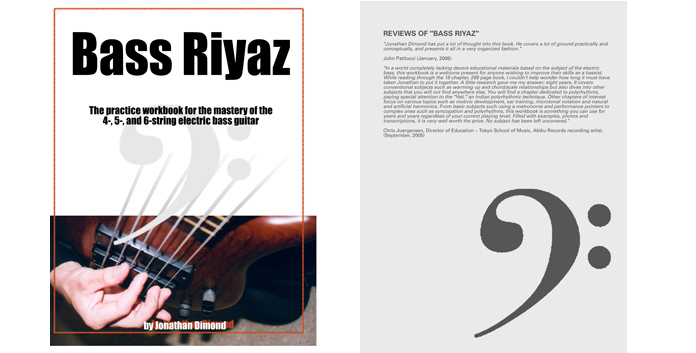
The term “Riyaz” comes from India where it means the all-embracing art of practice, with all its associated ritual, discipline, teacher-mentorship and sheer hard work. There are countless stories about the superhuman dedication and energy put into Indian musicians’ practice regimes in order to achieve virtuosic levels of artistry.
Bass Riyaz takes a wholistic approach to the development of craft on the electric bass guitar. It is necessary and part of the course of this book to touch on the philosophical, psychological, and physical aspects necessary to master oneself and one’s instrument. I hope that Bass Riyaz serves not only as a reference book kept on your bookshelf, but as a workbook that is a companion in your practice room every day.
The broad range of topics contained herein are relevant to musicians of any instrument, and so I encourage non-bassists to dig into these concepts and see if the meaning of “Riyaz” comes through to them also.
ABOUT "BASS RIYAZ"
Eight years in the making, this book is the culmination of years of teaching at University and also from my private studio. Begun in India and inspired from the rigours of studying Indian music, this book is 289 pages long. Over 87 pages of musical examples and dozens of illustrations and photographs support the text. The book is professionally laser-printed in black and white, and spiral bound with front and back covers.
REVIEWS OF BASS RIYAZ" Jonathan Dimond has put a lot of thought into this book. He covers a lot of ground practically and conceptually, and presents it all in a very organized fashion."
Reviewed by John Patitucci. (January, 2006)"In a world completely lacking decent educational materials based on the subject of the electric bass, this workbook is a welcome present for anyone wishing to improve their skills as a bassist. While reading through the 18 chapter, 289 page book, I couldn’t help wonder how long it must have taken Jonathan to put it together. A little research gave me my answer: eight years. It covers conventional subjects such as warming up and chord/scale relationships but also dives into other subjects that you will not find anywhere else. You will find a chapter dedicated to polyrhythms, paying special attention to the "Yati," an Indian polyrhythmic technique. Other chapters of interest focus on various topics such as motivic development, ear training, microtonal notation and natural and artificial harmonics. From basic subjects such using a metronome and performance pointers to complex ones such as syncopation and polyrhythms, this workbook is something you can use for years and years regardless of your current playing level. Filled with examples, photos and transcriptions, it is very well worth the price. No subject has been left uncovered."
Reviewed by Chris Juergensen, Director of Education – Tokyo School of Music, Abiku Records recording artist. (September, 2005)"I looked at your book and was thoroughly impressed with this vast body of well researched work. This work is certainly a great addition to the knowledge base of the modern bassist."
Reviewed by Kai Eckhardt. (July, 2006)"Those of you who know me, know that I have been a long-time “bass book geek”. I have an exhaustive collection of some of the best (concept, user-friendly, real lessons) bass books that have been published over the past 25 years. Having said this… I have finally found Bass Riyaz, written by the incredibly visionary bassist/multi-instrumentalist Jonathan Dimond. Jonathan gently guides the music student through the potentially dangerous musical maze beyond Western Music into the fertile environment ofrealWorld Music! By following his caring guidance the student will learn the importance of counting methods used in Indian Classical music and how to apply them to deep, cyclical grooves. Within a week of studying this book, it had become my momentary favorite – toppling the hierarchy of several books I have faithfully studied for YEARS! This is deep learning, folks! Very few music books (let alone bass books) are written as well as Bass Riyaz! I found myself drawn into the lessons almost immediately, and I continue to enjoy my time in this cool and peaceful learning place.
If you, as an ever-seeking music student, need to locate the next important juncture in your development… I strongly recommend Bass Riyaz. I contend this book is the “next greatest thing” in learning a deeper meaning of groove! Check out Jonathan at this website!"
Reviewed by Brent-Anthony Johnson. (June, 2007)